
How does a CIJ printer work?
Ink circulates continuously, and only the drops needed for the code reach the product. The rest return to the printer and are reused. The process has five stages:
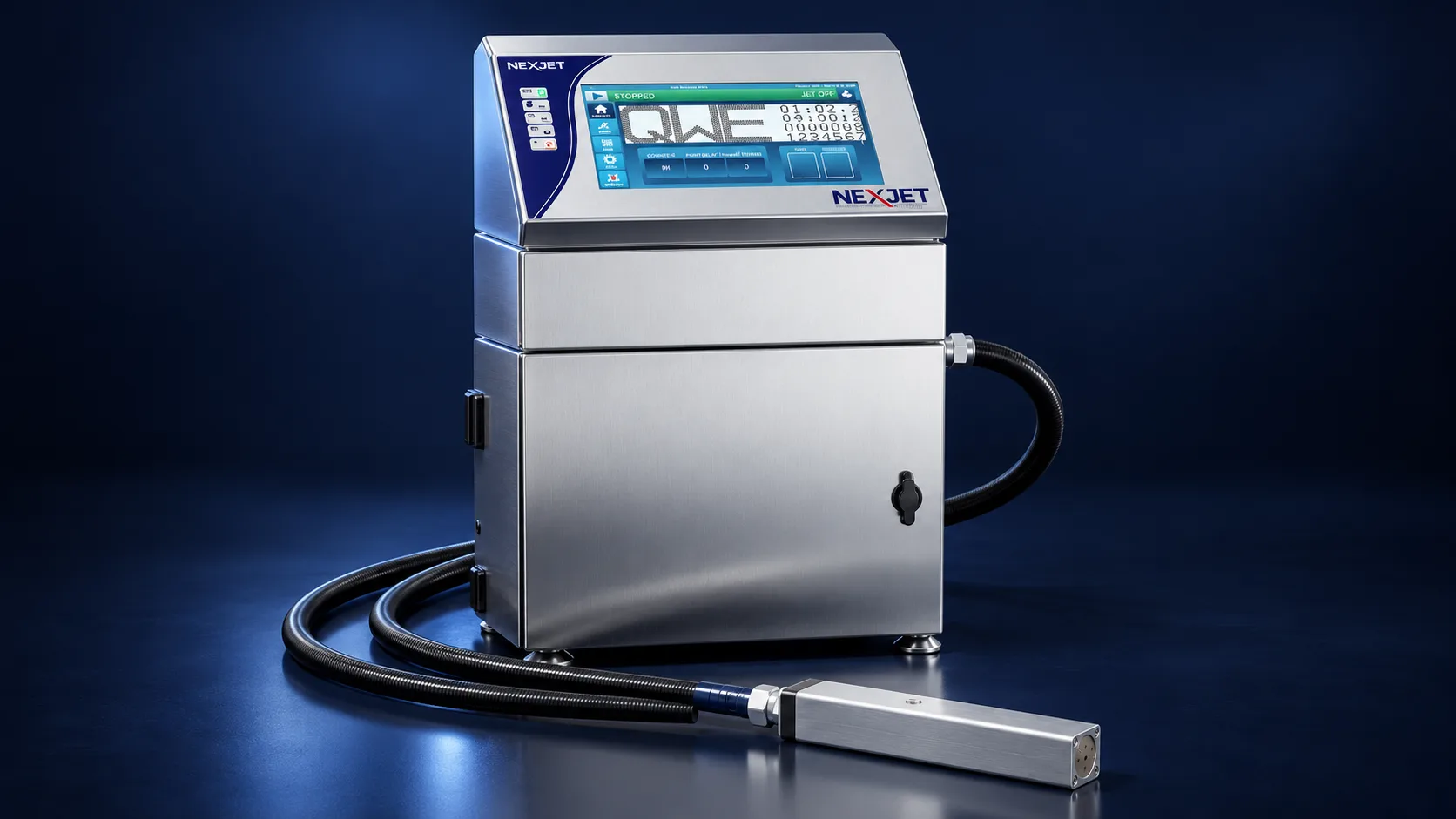
- Pressurised ink is pumped from the ink system in the cabinet to the printhead through a flexible conduit.
- A piezoelectric crystal vibrates the ink as it leaves the nozzle, breaking the jet into a steady stream of uniform drops.
- A charge electrode gives selected drops an electrical charge. The size of the charge decides how far each drop will be deflected.
- The drops pass between high-voltage deflection plates. Charged drops bend onto the product and build the characters dot by dot; uncharged drops fly straight into a gutter.
- Gutter ink is drawn back into the ink system and reused. Because solvent evaporates during this loop, the printer adds make-up fluid to hold the ink at the correct viscosity.
Nothing touches the product, and the drops cross a small air gap. That is why CIJ can code curved bottles, cable sheath and uneven surfaces that a contact printer or a short-throw printhead would struggle with.
What can a CIJ printer print?
CIJ prints dot-matrix text and simple graphics, usually in one to a few lines. Typical content includes:
- Production, expiry and best-before dates, calculated automatically by the printer
- Batch and lot numbers, shift codes and times
- Counters and sequential numbers, such as length marking on cable
- Simple logos and symbols
- Barcodes and 2D codes such as DataMatrix, within the limits of dot size. Readability should always be checked with a scanner on the real product.
For Saudi and GCC labelling, confirm that the specific model supports Arabic fonts and Hijri as well as Gregorian dates before you buy. Support varies by manufacturer and software version.
Which materials and products suit CIJ?
CIJ codes most rigid and semi-rigid surfaces, porous or non-porous, as long as the ink is matched to the material. Common applications:
- Glass and PET bottles, caps and closures
- Metal cans and aluminium packaging
- HDPE, PP and PVC containers, pipes and profiles
- Cable and wire insulation during extrusion
- Cartons, sleeves and shrink-wrapped packs
The ink is the deciding factor. Fast-drying solvent inks adhere to plastics, glass and metal. Pigmented inks, such as white or yellow, give contrast on dark cable, pipe and black plastic. Specialised inks exist for wet or condensing surfaces, for packs that go through sterilisation, and for other demanding conditions. Every adhesion or contrast claim should be proven by printing on your own samples under real line conditions.
Where does CIJ fit on a production line?
CIJ is built for continuous, multi-shift production where the product moves past a fixed printhead. Typical lines include:
- Filling and capping lines for water, juice, dairy and soft drinks
- Can and closure lines
- Cable, wire and pipe extrusion, often with length counting
- Secondary coding on bags, cartons and shrink-wrapped packs
The printhead is mounted on a bracket beside the conveyor. A product-detect sensor triggers each print, and a shaft encoder keeps the code length correct when line speed changes. Most printers can also exchange data and status signals with a PLC or line controller.
What are the limitations of CIJ?
CIJ trades some print quality and simplicity for speed and versatility. Plan for these points:
- Print quality: characters are dot-matrix. For high-resolution text, logos and dense 2D codes on cartons, thermal inkjet or laser is usually the better fit.
- Consumables: CIJ uses both ink and make-up fluid. Make-up consumption rises in hot environments because solvent evaporates faster.
- Maintenance: filters, the printhead and the ink system need scheduled service. Following the correct start-up and shut-down sequence reduces nozzle blockages.
- Solvents: most CIJ inks are solvent-based, so ventilation, storage and handling rules apply. Always follow the safety data sheet.
Does CIJ work in hot, humid or dusty factories?
Yes, provided the printer is specified and installed for those conditions. Heat, humidity and dust affect every CIJ printer, so rely on the verified operating range of the specific model, never a generic figure. Before installing in a Saudi or GCC production hall:
- Check the minimum and maximum operating temperature and humidity in the model's datasheet, including whether condensation is permitted.
- Ask whether the printhead has an air purge (positive air pressure), which helps keep dust and moisture out.
- Check the cabinet's ingress-protection (IP) rating for dusty or washdown areas.
- Budget for higher make-up consumption in hot halls, and store ink within its stated temperature range.
When is CIJ the right choice?
Choose CIJ when the product moves continuously, the surface is curved or non-porous, and you need a small code of a few lines on glass, plastic, metal or cable across multiple shifts. NEXJET's CIJ coding inkjet printer is designed for this kind of line.
Consider another technology when:
- you need sharp text, logos or 2D codes on cartons: an inline thermal inkjet (TIJ) printer gives higher resolution with less maintenance;
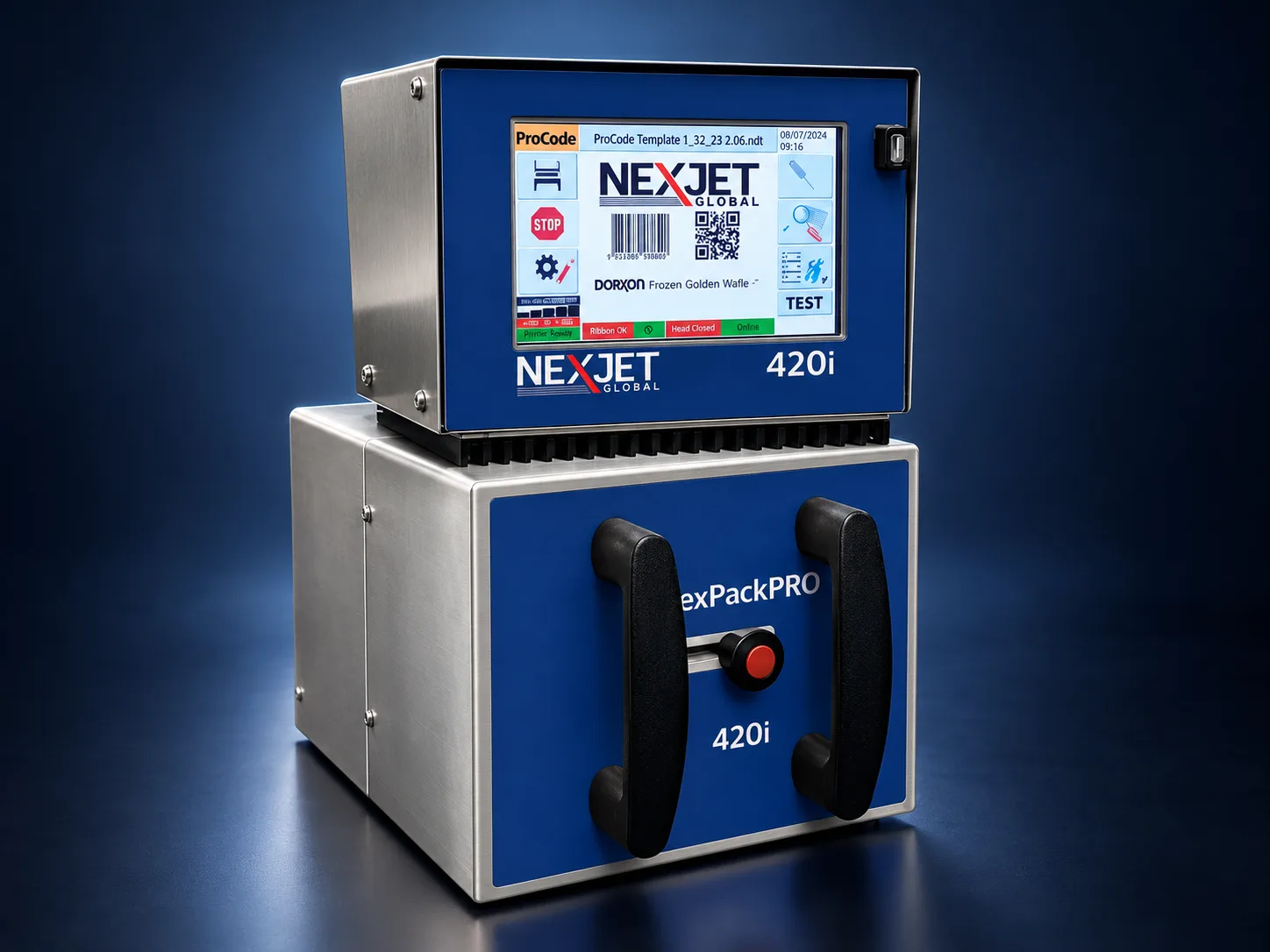
- you code flexible film on a packaging machine: a thermal transfer overprinter (TTO) is usually the better match;
- you want a permanent mark with no ink at all: consider fiber, CO2 or UV laser marking, depending on the material;
- coding is occasional or low volume: a cartridge-based handheld TIJ printer needs no ink system at all.
Not sure yet? Start with our guide to choosing a coding technology by material.
Frequently asked questions
How fast can a CIJ printer print?
It depends on the number of lines, character height, font and nozzle size, so speed is only meaningful for a defined code. Ask for the maximum line speed at your actual code format, not a headline figure.
Can CIJ print on wet or cold bottles?
Wet, cold or condensing surfaces need an ink formulated for them. Test on samples taken from the line under production conditions: adhesion on a dry sample does not prove adhesion on a wet one.
Is CIJ ink safe for food packaging?
CIJ inks are normally printed on the outside of packaging, not on food. Direct marking of food requires inks specifically qualified and documented for that use.
What does a CIJ printer cost to run?
Running cost is ink and make-up fluid, plus filters and service. Calculate it per 1,000 codes using your real code size, line utilisation and factory temperature, rather than a catalogue estimate.
Can a CIJ printer print Arabic and Hijri dates?
Many can, but not all. Confirm Arabic font support, right-to-left text and Hijri date calculation for the exact model and software version before ordering.
Editorial guidance informed by the NEXJET company catalogue. This is not a model-specific datasheet.